



Individual Agency and Network Structures in 19th–20th-Century Musical Life
An International Conference
Organised by the Institute for Musicology of the ELTE Research Centre for the Humanities and the IMS Study Group Music and Cultural Studies
3–4 December 2026
Institute for Musicology of the ELTE RCH
Táncsics Mihály utca 7, 1014 Budapest
Bartók Hall
Digital Critical Editions in Music
online workshop series
Organized by the Hungarian Department for Hungarian Music History,
Institute for Musicology of the ELTE RCH
Table of Contents
Digital Critical Editions in Music 1. – Two Projects of the Frydryk Chopin Institute
Digital Critical Editions in Music 3. – Beethovens Werkstatt: A Digital Edition of Notirungsbuch K.
Digital Critical Editions in Music 1. – Two Projects of the Frydryk Chopin Institute
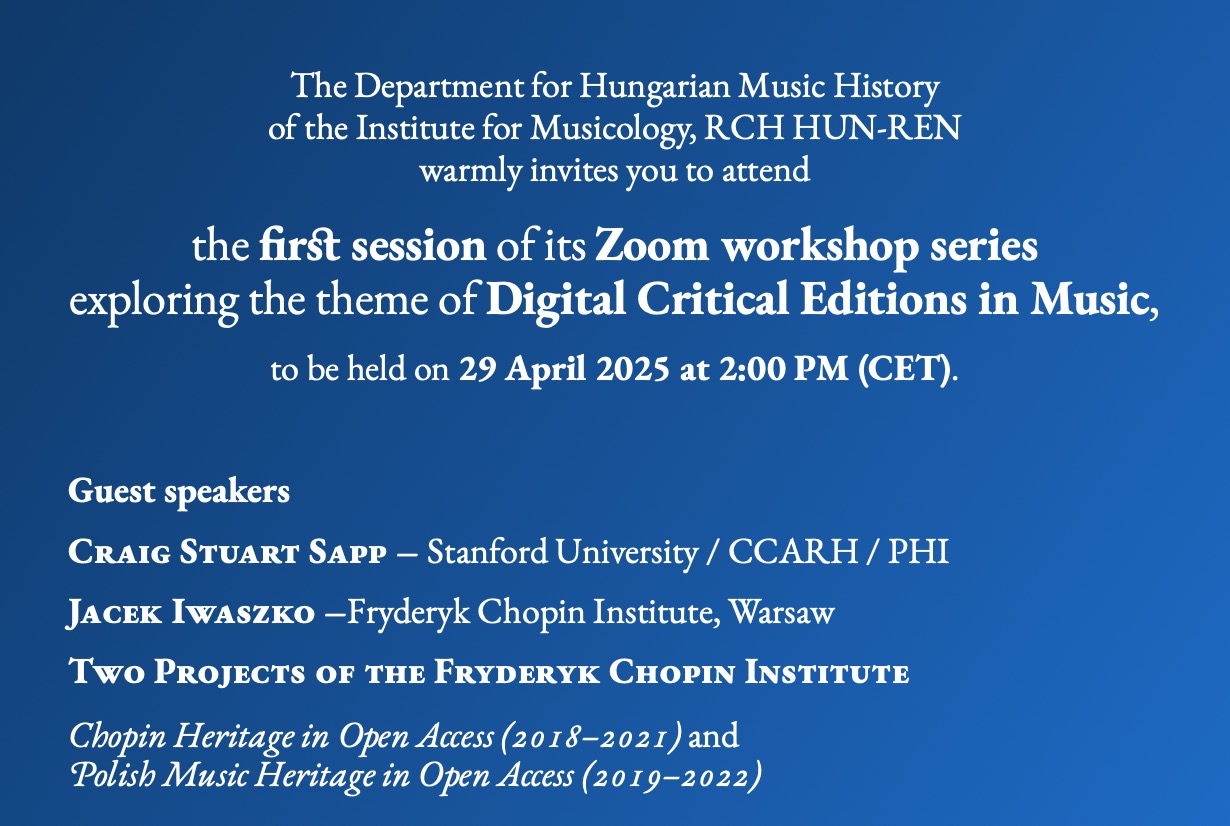
Monday, April 29, 2025, at 2:00 PM.
Jacek Iwaszko (Fryderyk Chopin Institute, Warsaw)
Craig Stuart Sapp (Stanford University / CCARH / PHI)
Two Projects of the Fryderyk Chopin Institute
Chopin Heritage in Open Access (2018–2021) and Polish Music Heritage in Open Access (2019–2022)
The detailed invitation can be downloaded here.
The presentation discusses the outcomes of two EU-funded projects conducted Fryderyk Chopin Institute between 2018 and 2022.
Among the results of the Chopin Heritage in Open Access project (2018–2021) is the portal chopinscores.org, featuring over 500 digital scores of Chopin’s first editions encoded in the Humdrum format. The platform offers advanced tools for analysis and comparison, including melody, rhythm, and interval search, tonal analysis, and dynamic score visualization.
The Polish Music Heritage in Open Access project (2019–2022) extends these methods to a broader repertoire of music from the 16th to 19th centuries. Creating 8,000 digital scores in Humdrum format required the development of a Git-based editorial workflow. The polishscores.org portal offers an advanced musical search engine, filtering options, and an analytical toolkit. All scores are available under an open license in multiple formats, providing a scalable model for digital editing, access, and computational analysis.
Digital Critical Editions in Music 2. – Critical Text and Digital Interactive Database of Čiurlionis’s Piano Music
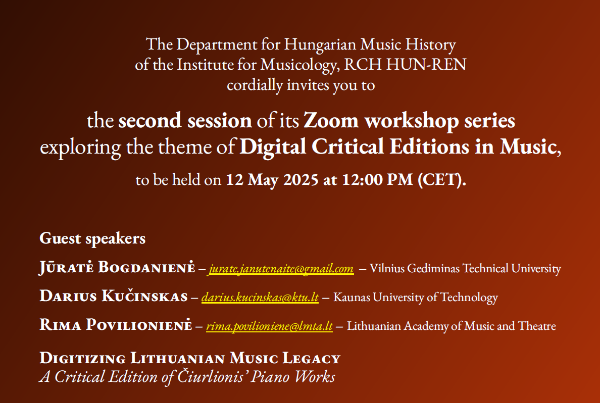
Monday, May 12, 2025, at 12:00 PM.
Jūratė Bogdanienė (Vilnius Gediminas Technical University)
Darius Kučinskas (Kaunas University of Technology)
Rima Povilionienė (Lithuanian Academy of Music and Theatre)
Critical Text and Digital Interactive Database of Čiurlionis’s Piano Music (https://piano.ciurlionis.eu/)
The detailed invitation can be downloaded here.
The session presents a 2022–2024 research focused on the piano music of renowned Lithuanian composer and painter Mikalojus Konstantinas Čiurlionis. The research was funded by Research Council of Lithuania under the project Critical Text and Digital Interactive Database of Čiurlionis’s Piano Music (No. P-LIP-22-101). The goal was to prepare a critical edition of the composer’s piano works and to publish it as an interactive database, aiming to reflect broader trends in contemporary (digital) editing and publishing of musical works. The developed database includes both complete and incomplete piano works by Čiurlionis, as well as sketches and fragments. The access to 356 entries of digital scores, combining XML-coded variants and critical editions linked and presented alongside their autographs, contemporaneous transcriptions, previous publications, and detailed commentary, and is available at https://piano.ciurlionis.eu/. Additionally, a unique search algorithm was programmed and integrated into the database, enabling music information retrieval based on basic criteria and allowing for comparative analysis of the works and fragments contained within the system.
Digital Critical Editions in Music 3. – Beethovens Werkstatt: A Digital Edition of Notirungsbuch K.
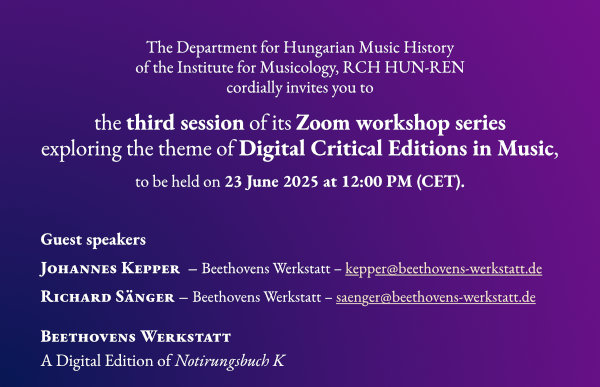
Monday, June 23, 2025, at 12:00 PM.
Johannes Kepper (Beethovens Werkstatt)
Richard Sänger (Beethovens Werkstatt)
Beethovens Werkstatt
A Digital Edition of Notirungsbuch K.
The detailed invitation can be downloaded here.
The basic musicological research project “Beethoven’s Workshop” focuses on genetic text criticism combined with digital music editing, offering new perspectives in musicological research. This project examines Beethoven’s compositional processes and employs digital technologies to disseminate its findings.
In the fourth module, which addresses sketches, Beethoven’s sketchbook from early 1823, known as Notirungsbuch K, will be digitally reconstructed and made accessible. Each sketch’s scriptural characters will be recorded from the manuscripts and correlated with corresponding diplomatic and annotated transcriptions. This linkage aims to create an animated presentation that transparently illustrates the transition from facsimile to transcription, or from recording findings to interpretation, for users.
In this presentation, we will introduce the project and its methodological approaches, explain the use of digital tools, mechanisms of the encoding, and present the results and objectives of the fourth module of “Beethoven’s Werkstatt.” The presentation will highlight the advantages of digital music editing for research and teaching, such as enabling collaborative work, interactive visualization of text variants, and the provision of comprehensive metadata.
Digital Critical Editions in Music 4. – E-LAUTE: An Electronic Linked Annotated Unified Tablature Edition

Wednesday, December 10, 2025, at 2:00 PM
Kateryna Schöning, PD Dr (University of Vienna)
Ilias Kyriazis, MMus, MA, MLS (Austrian National Library)
E-LAUTE
An Electronic Linked Annotated Unified Tablature Edition
The detailed invitation can be downloaded here.
E-LAUTE (Electronic Linked Annotated Unified Tablature Edition, https://e-laute.info) is a research project establishing an open-access, comprehensive, interactive edition of music in lute tablature from the German-speaking area 1450-1550. Though formerly well-known and widely performed, this corpus has become inaccessible to scholars, musicians, and the general public due to its complex notation and its sources being scattered throughout Central Europe. E-LAUTE sustainably digitises this part of European cultural heritage as machine-readable encodings, unlocked for a contemporary audience through transcriptions and professional recordings. The data is enriched with music-historical and performance-practical metadata, forming the basis for a novel form of music edition, an ‘open knowledge platform’, in which musicology, music practice, music informatics, and literary studies intertwine. The edition is permanently hosted by the Austrian National Library (ÖNB, https://edition.onb.ac.at/ context:elaute). The presentation will offer an overview of the project, addressing both content and technical characteristics
Musical Discourses on the National Idea in the 19th and 20th Centuries:
Music Historiography and Criticism Revisited
An International Conference to celebrate the 200th anniversary of the Hungarian Academy of Sciences
Organised by the Institute for Musicology of the ELTE Research Centre for the Humanities and the IMS Study Group Music and Cultural Studies
4-5 December 2025
Institute for Musicology of the ELTE RCH
Táncsics Mihály utca 7, 1014 Budapest
Bartók Hall and Haydn Hall
About
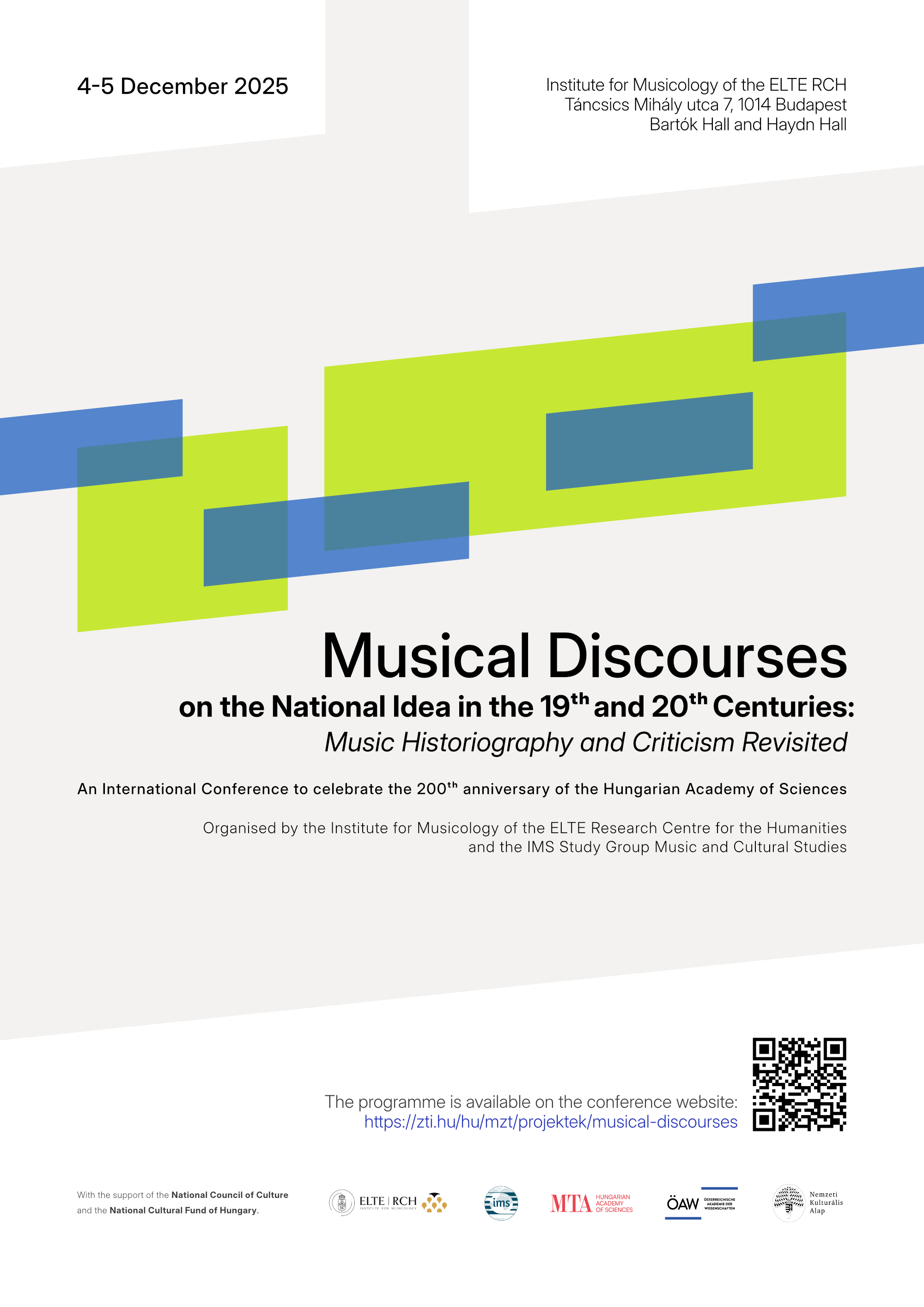 The Department of Hungarian Music History of the ELTE RCH Institute for Musicology and the International Musicological Society Study Group Music and Cultural Studies are holding a two-day international conference on musical discourses on cultural nation building in the 19th and 20th centuries in music historiography and music criticism. The event also pays tribute to the 200th anniversary of the founding of the Hungarian Academy of Sciences.
The conference will be held in person, but the presentations will also be broadcast live via Zoom by the Institute of Musicology and will be made available on the Institute's website at a later date. To watch the live broadcast, click on the links in the program a few minutes before the event begins.
Useful information
Information on public transport, tickets, restaurants
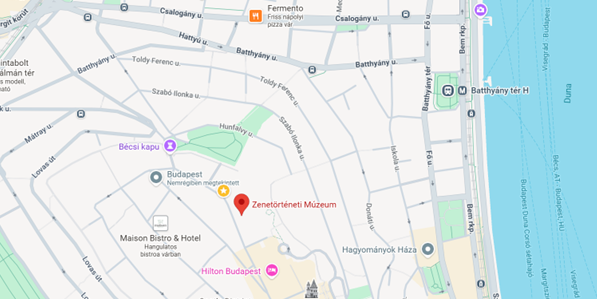
The venue of the conference
ELTE HTK Zenetudományi Intézet / Zenetörténeti Múzeum
Budapest, Táncsics Mihály u. 7, 1014
Bartók Hall and Haydn Hall
Public transportation
Public transportation is well-organized and reliable in Budapest. Google Maps is practical and also reliable for planning routes.
The conference venue is most easily reached by buses 16, 16A, and 216.
Approaching from Széll Kálmán tér, take buses 16 or 16A and get off at Bécsi kapu tér.
Approaching from Deák Ferenc tér, bus 16 is recommended; get off at Szentháromság tér or Bécsi kapu tér.
Bus 216 turns toward the Buda Palace buildings, so if you take this line, it is best to get off at Schulek Frigyes lépcső. From there, going up the stairs will take you to the Fisherman’s Bastion (Szentháromság tér) in either direction.
If you prefer to avoid stairs or longer walks, bus 16 (or 16A from Széll Kálmán tér) is recommended.
Tickets for Public transport
Tickets can be purchased from ticket machines troughout the city or through the BudapestGo mobile application. The app is more practical, as unused tickets can be refunded and the cost is reimbursed immediately.
Call for Papers
Convenors:
Katalin Kim, Deputy Director of the Institute for Musicology ELTE RCH, Head of the Department for Hungarian Music History, Budapest
Tatjana Marković, Project Chair at the Department of Musicology ACDH, Austrian Academy of Sciences, Vienna, Chair of the IMS Study Group Music and Cultural Studies
In 19th- and early 20th-century music historiography and criticism, the question of national identity emerged as a central concern – both in normative and projective terms. Normatively, these discourses on music history and musical life (including music criticism related to composition, performance, repertoire, music publishing, and music education) actively contributed to the formation of national identity, with their authors—music historians, critics, aestheticians, and others – often playing key roles in broader efforts of cultural nation-building. Additionally, in some cases the idea of national identity was formed in parallel with the supranational identity, or redefined it, in accordance with political and cultural contexts in different areas.
Music criticism—as one of the defining genres of the emerging bourgeois musical public sphere—and the music-historical writings of this period, particularly the first major syntheses produced during and about the era of cultural nation-building (in Hungary, notably around the time of the *Millennium celebrations at the turn of the century), articulated national canons and constructed enduring national narratives. Furthermore, musicology as an academic discipline was established after World War II and was based, in some cases, on the multiple identities (Socialist Yugoslavia).
The processes of modernization and bourgeois transformation were frequently embedded within narratives of supranational and national self-definition. Often authored by contemporaries, these early historical syntheses were, for a long time, received by later scholarship with insufficient critical distance—especially given that music historiography has only begun in recent decades to move beyond, or even question, the framework of the cultural national narrative. This observation holds not only for Hungary but arguably for other countries in the region and beyond as well.
A discourse-analytical investigation of 19th- and early 20th-century music historiography and criticism—especially when studied in conjunction with the musical life and institutions of the period—can shed light on deeply embedded discursive structures, rhetorical topoi, recurring patterns, and unexamined metaphors that deserve renewed reflection and critique.
Through the critical analysis of the often still deeply rooted national discourse of the 19th and early 20th centuries, it becomes clearer that national identity—and with it, national music—is always a mixture of cross-cultural exchanges beyond borders, or within a single space (a region), as a blend of different voices.
By subjecting the authors and writings of nationally focused music historiography and criticism to critical analysis, and examining the polemics that unfolded through them, we can uncover not only the strategies and processes of cultural nation-building, but also identify the actors (minorities, women, minor masters, etc.), locations, networks, and different cultural memories that were omitted, excluded, or not integrated into the national narrative.
At the same time, this perspective reveals not only the multifaceted nature of the sources and backgrounds of national identity and national music, but also the constancy and complexity of musical transfer processes—demonstrating the presence of a fluid geographical transfer. This appears most prominently in border and contact zones, but was essentially present throughout the entire territory of multi-ethnic states, such as Hungary / Habsburg Monarchy or later Yugoslavia in the 19th and early 20th centuries, in varying cultural, ethnic, and religious compositions. All of these aspects reflect not only the coexistence and interaction of these various identities but also the presence—persisting in part into the late 19th century and beyond— of multiple identities: the simultaneous experience of cultural-linguistic national identity and political national identity (the Hungarus consciousness), further complemented by regional, cultural, religious, and other identities, or supranational south Slavic identities.
Music historiography has only recently begun to confront this complexity (see, for example, studies of border regions). In this regard, the critical analysis of 19th- and early 20th-century musical discourse, through the identification of earlier patterns, can promote the self-reflection of present-day music historiography and open the way toward a shared historiography.
This conference is organized to celebrate the 200th anniversary of the Hungarian Academy of Sciences.
We invite papers engaging with (but not limited to) the following themes:
- Discourse-analytical studies on the construction of supranational and national identity in 19th- and early 20th-century music historiography and criticism (e.g. discourse analysis, intertextuality, hybrid identity);
- Studies on the emergence, consolidation, and redefinitions of national music canons, their mechanisms, and historiographical strategies, in relation to current knowledge about the musical life and composition of the period (e.g., canon studies, narrative analysis);
- Examinations of the key figures involved in canon formation and deconstruction, and nation-building (e.g. critics, historians, editors);
- Research on the role of key institutions and platforms—such as journals, music societies, academies, museums, libraries, publishers, and other cultural institutions—in shaping, deconstructing, and reconstructing national canons and narratives in music history;
- Reflections on historiography’s engagement with supranational and national narratives, both in its uncritical adoption and its more recent critiques and revisions.
Venue
Budapest, Institute for Musicology of the ELTE RCH, Bartók Hall and Haydn Hall
Programme Committee
Pál Richter, Institute for Musicology ELTE RCH, Budapest
Alexandros Charkiolakis, The Friends of Music Society, Athens
Zdravko Blažeković, Executive Director of RILM, City University Graduate Center, New York
Leon Stefanija, University of Ljubljana
Rūta Stanevičiūtė, Lithuanian Academy of Music and Theatre, Vilnius
Rima Povilionienė, Lithuanian Academy of Music and Theatre, Vilnius
Lenka Křupková, Palacký University, Olomouc
Programme
4 December 2025
|
BARTÓK HALL 8:30–10:45
|
|
|
8:30 Registration 9:00 Opening Pál Richter, Director of the Institute for Musicology ELTE RCH, Head of the Archives and Department for Folk Music and Folk Dance Research Balázs Borsos, Deputy Director of the Institute of Ethnology ELTE RCH, President of the I. Section of Linguistics and Literary Scholarship of the Hungarian Academy of Sciences Katalin Kim, Deputy Director of the Institute for Musicology ELTE RCH, Head of the Department for Hungarian Music History Tatjana Marković, Project Chair at the Department of Musicology, ACDH, Austrian Academy of Sciences, Vienna, Chair of the IMS Study Group Music and Cultural Studies
From the History of Hungarian Music to the Musical History of Hungary by the members of the Institute for Musicology, Research Centre for the Humanities ELTE, Budapest
Ágnes Papp, senior research fellow, Department for Hungarian Music History The Burden of Writing Music History. Preparatory Work for the First Two Volumes of the History of Music in Hungary at the Institute for Musicology of the Hungarian Academy of Sciences (1970–1990)
Katalin Kim, Deputy Director of the Institute for Musicology ELTE RCH, Head of the Department for Hungarian Music History The Music History of Hungary III–IV. Research on the 18th–19th Centuries at the Institute for Musicology
Anna Dalos, Head of the Archives for 20th–21st Century Hungarian Music Music History of Hungary. About the 20th-century volume
László Vikárius, Head of the Bartók Archives, General Editor of the Béla Bartók Complete Critical Edition Fifteen Hungarian Peasant Songs in the Béla Bartók Complete Critical Edition and Its Possible Role in Musical Discourses on National Identity
Pál Richter, Director of the Institute for Musicology ELTE RCH, Head of the Archives and Department for Folk Music and Folk Dance Research Great Comprehesive Works: Hungarian Folk Music – Catalogue of Hungarian Folksong Types
|
|
|
10:45-11:30 Keynote chair Katalin Kim
Barbara Boisits, Head of the Department of Musicology, ACDH, Austrian Academy of Sciences, Vienna Guido Adler: Internationalization of musicology during the heyday of nationalism?
|
|
|
11:30–12:00 Coffee break
|
|
|
Bartók Hall 12:00–13:30 |
Haydn Hall 12:00–13:30 |
|
National music historiography redefined chair: Tatjana Marković
Rūta Stanevičiūtė, Lithuanian Academy of Music and Theatre, Vilnius Theory of music historiography and “nationality syndrome”: Toward re-assessment of Lithuanian music history writing
Philippe Gumplowicz, Paris Saclay University French musical taste between the national and the popular
Lenka Křupková, Palacký University Olomouc Redefining the national narrative: Music historiography and socialist realism in 1950s Czechoslovakia |
Germanic versus Italian/French discourses chair: Anna Dalos
Andrea Agresti, University of Vienna Between nationalism and universalism: Musical discourses on the Second Viennese School in fascist Italy
Francesco Finocchiaro, “G. Rossini” Conservatoire of Pesaro ‘Parallel lives’: The anti-German controversy in early 20th-century Italian music historiography [Online]
Louise Guérot, University of Strasbourg, University Paris 1 Panthéon-Sorbonne University Music and national identity: French musical policy in Germany and Austria (1945-1955) |
|
13:30–15:00 Lunch break Meanwhile: Guided tour in the exhibition Musicological Research under the Auspices of the Hungarian Academy of Sciences (1825–2025). Exhibition at the Museum of Music History of the Institute for Musicology. Curator: Anna Dalos.
|
|
|
Bartók Hall 15:00–16:30 |
Haydn Hall 15:00–16:30 |
|
À la hongroise 1 chair: Pál Richter
Adrienne Kaczmarczyk, Institute for Musicology ELTE RCH, General Editor of the New Liszt Complete Critical Edition, Budapest Liszt’s criticism of Zigeunermusik
Bianca Schumann, University of Music and Performing Arts, Vienna Too ‘Eastern’ to be ‘ours’? Franz Liszt’s national identity in Viennese music criticism (1857–1900)
Zsolt Vizinger, Institute for Musicology ELTE RCH, Budapest Hungarian style in chamber music: The reception of works by Schubert, Brahms and Hungarian composers in Pest in the 19th century |
Germanic versus Eastern European discourses chair: Lenka Křupková
Lili Veronika Békéssy, Institute for Musicology ELTE RCH, Budapest Circulating music news: Press networks between Vienna and Pest-Buda in 1857
Lukas Mantovan, Bruckner University, Linz On the discoursive construction of Hungarian (national) music in German-language writing in the early 19th century
Ádám Ignácz, Institute for Musicology ELTE RCH and Jan Blüml, Palacký University Olomouc Popular music magazines in communist Eastern Europe: A comparative study of East Germany and Czechoslovakia |
|
16:30–16:45 Coffee break
|
|
|
16:45–17:45
Eva-Maria de Oliveira Pinto, Berlin/Munich National school and canon formation - Jenő Hubay and a multi-identitarian Hungarian Violin School
Emese Tóth, Liszt Ferenc Academy of Music, Budapest Inherited and Chosen Topoi – Musical Iconographic Symbols in 19th- and 20th-century Buildings in Pest-Buda |
16:45–17:45
Christiane Tewinkel, Lübeck University of Music Reading notes, being German. The evolvement of concert program notes in Western Germany, 1945-2015
Rima Povilionienė, Lithuanian Academy of Music and Theatre, Vilnius The First Experiments of Lithuanian Electronic Music in the 1960s-70s [Online] |
5 December 2025
|
Bartók Hall 9:30–11:00 |
Haydn Hall 9:30–11:00 |
|
Session of the Study Group Music and Cultural Studies: Reframing narratives of national histories of music in Southeast Europe chair: Katalin Kim
Tatjana Marković, Austrian Academy of Sciences, Vienna Pluriculturalism versus nationalism: Inclusive history of music
Leon Stefanija, University of Ljubljana Mapping nationalisms since the long 19th century in Slovenian musicological thought
Georgia Petroudi, European University Cyprus, Nicosia Trauma and the reconfiguration of national identity in Cypriot musical discourse |
Individual contributions to nationalism definition chair: Lili Veronika Békéssy
Yusuke Nakahara, Institute for Musicology ELTE RCH, Budapest; University of Osaka Pursuing the ideal of a ‘national composer’: The case of Bartók’s and Liszt’s reception in Japan
Beáta Simény, Institute for Musicology ELTE RCH, Budapest Sámuel Brassai’s Music Criticism in Pest (1853): Nation-Building and Cultural Education
Emese Sófalvi, Babeș-Bolyai University, Cluj-Napoca Delayed Hungarisms. Ödön Farkas and the scene of Transylvanian music at the end of the 19th century
|
|
11:00–11:15 Coffee break
|
|
|
11:15–12:15
Alexandros Charkiolakis, The Friends of Music Society, Athens Building national conscience: Kalomiris’ Manifesto on national music
Dilara Turan, Yıldız Technical University, Istanbul Rethinking national discourses in Turkish contemporary music: Yeni Müzik and the politics of cultural identity [Online] |
11:15–12:15
Marianne Betz, University of Music and Theatre “Felix Mendelssohn Bartholdy”, Leipzig “Is it not the music teachers and composers that govern the music of the people?” George Whitefield Chadwick (1854–1931), composer, educator, cultural manager
Margarita Pearce Pérez, University of La Laguna and Iván César Morales Flores, University of Oviedo Alejo Carpentier (1904–1980) and the history of La música en Cuba: A historiographical reassessment through the (de/re)construction of canons and national narratives |
|
12:15–12:45 Coffee break
|
|
|
Bartók Hall 12:45–14:15 |
Haydn Hall 12:45–14:15 |
|
Stage music chair: Rūta Stanevičiūtė
Pál Horváth, Institute for Musicology ELTE RCH, Budapest Collective working practices of the multilingual ensemble of the National Theatre in Pest in the 1850s
Petra Babić, Catholic University of Croatia, Zagreb The use of historical operas in the creation of national master narrative
Katalin Ágnes Bartha, Babeș-Bolyai University, Faculty of Theatre and Film, Cluj-Napoca Ira Aldridge and the sound of resistance: Music, theatre and national identity in 1850s Hungary |
À la hongroise 2 chair: Máte Cselényi
Szabolcs Illés, Institute for Musicology ELTE RCH, Budapest Sounding Hungarian Music History in the 19th Century
Lydie Chapoton, Sorbonne Université - IReMus, Paris Stylistic circulations in 19th-century Europe: The style hongrois in the finales of Johannes Brahms’ opp. 25 and 26
Lilla Dóra Bokor, Liszt Ferenc Academy of Music, Budapest National Sentiments in Music: Ede Reményi’s 1860–61 Hungarian Concert Tour and it’s Croatian Interlude
|
|
14:15–15:30 Lunch break
|
|
|
Bartók Hall 15:30–17:00 |
Haydn Hall 15:30–17:00 |
|
National music canon under re/consideration 1 chair: Tatjana Marković
Jana Laslavíková, Slovakian Academy of Sciences, Bratislava Slovak musical life in the years 1918–1938: a dream fulfilled and unfulfilled expectations [Online]
Rudolf Gusztin, Institute for Musicology ELTE RCH, Budapest Three Layers of the National Narrative in Hungary in the Second Half of the 19th century
José Miguel Pérez Aparicio, Autonomous University of Barcelona On the search of a Catalan national genre of lyric theatre (1897–1922): a historiographical redefinition through the concept of segmented pluralism
|
National music canon under re/consideration 2 chair: Alexandros Charkiolakis
Kristina Perkola, University for Business and Technology, Prishtina Canon Formation and identity: Institutions, composers, and festivals in Kosovo’s art music, 1945–1990
Argyrios Kokoris, Aristotle University of Thessaloniki Borders of sound: Canon formation and the national idea in the Greek press of Thessaloniki, 1912–1922
Kamille Gagné, University of Montréal, University of Fribourg Folklore as an instrument of identity: Marius Barbeau (1883–1969) and the making of Franco-Canadian's musical nationalism |
17:00–17:15 Break
|
|
BARTÓK HALL 17:15–17:30 Closing remarks Katalin Kim and Tatjana Marković |
|
HAYDN HALL 17:30 Wine toast with traditional music from Hungary (performed by the members of the Archives and Department for Folk Music and Folk Dance Research of the Institute for Musicology, ELTE Research Centre for the Humanities) |
A „Towards a common regional history of our nation building strategies. Traveling directors, musicians” elnevezésű Visegrad Grants 2020–2021 projekt információs oldala. További információk a bal oldalon található menüpontokra kattintva találhatók.
A „The Network of the Musical Theatre Companies in the Multilingual East-Central Europe” elnevezésű Visegrad Grants 2017–2018 projekt információs oldala. A projekt a nemzetközi együttműködés volt, így leírása angol nyelvű. További információk a bal oldalon található menüpontokra kattintva találhatók.
Hymnusz-emléknap
Ismertető

„Itt az írás, forgassátok
Érett ésszel, józanon”
Emléknap és kamarakiállítás a Hymnusz megzenésítésének 175. évfordulója alkalmából
Az MTA BTK Zenetudományi Intézet egész napos rendezvénnyel ünnepli Kölcsey Ferenc nemzeti és állami szimbólummá vált költeménye megzenésítésének 175. évfordulóját a Magyar Zenetörténeti Osztály szervezésében, dr. Áder János köztársasági elnök úr fővédnökségével. Erkel Ferenc pályadíjas műve – melynek pályázati példányára maga a szerző jegyezte fel a rendezvény mottójaként választott Kölcsey-idézetet – először 1844. július 2-án hangzott el a pesti Nemzeti Színház színpadán.
A Hymnusz-emléknap alkalmából tervezett program a szűkebb szakma mellett szélesebb közönséget is megszólít. Kétfordulós országos zenetörténeti diákvetélkedő keretében az 1844-es pályázat kontextusát, szereplőit és a Hymnusz törvényi rangra emelésének főbb állomásait idézzük fel. A Zenetörténeti Múzeum állandó kiállításának részeként elhelyezett tárlókban pedig a legfontosabb eredeti forrásokon keresztül is bemutatjuk – részben új kutatásokra alapozva – a Hymnusz kanonizálásának és nemzeti emlékhellyé válásának folyamatát. A kamarakiállítás megnyitójához két zene- és irodalomtörténeti előadás, valamint egy hangverseny kapcsolódik.
Dátum & helyszín: 2019. június 12., MTA BTK Zenetudományi Intézet (1014 Budapest, Táncsics Mihály u. 7.).
A Hymnusz-emléknap programja
MTA BTK Zenetudományi Intézet Haydn terem
11:00 – 14:00 – Játékos magyar zenetörténet. Vetélkedő általános és középiskolák, valamint zeneiskolák 13–16 éves diákjai számára a Hymnusz keletkezéséről és nemzeti kultuszgyakorlatának történetéről. A verseny döntője.
MTA BTK Zenetudományi Intézet Bartók terem
16:00 – 17:00 – Bevezető előadás és hangverseny: A megjelenteket üdvözli Richter Pál, a Zenetudományi Intézet igazgatója. Bevezető előadást tart Földesi Ferenc, az Országos Széchényi Könyvtár különgyűjteményi igazgatója és Kim Katalin, a Zenetudományi Intézet Magyar Zenetörténeti Osztályának vezetője ismerteti a Játékos Magyar Zenetörténet eredményeit és az Erkel-műhely kiállítást. A Magyar Nemzeti Bank Hymnusz-emlékérme pályázatát ismerteti Horváthné Rudolf Teréz, a Magyar Pénzverő Zrt. vezérigazgatója.
A hangversenyen közreműködnek Balog József Liszt Ferenc-díjas zongoraművész és a Liszt Ferenc Zeneművészeti Egyetem Népzene Tanszékének hallgatói.
MTA BTK Zenetudományi Intézet Zenetörténeti Múzeum
17:00 – 17:30 – Kiállításmegnyitó. A kiállítást a Zenetörténeti Múzeum 2. termében bemutatják a Magyar Zenetörténeti Osztály munkatársai.
Versenyfelhívás
Játékos Magyar Zenetörténet
Vetélkedő a Hymnusz megzenésítésének 175. évfordulója alkalmából
Kedves Diákok és Tanárok!
Az MTA BTK Zenetudományi Intézet egész napos rendezvénnyel ünnepli Kölcsey Ferenc költeménye megzenésítésének 175. évfordulóját a Magyar Zenetörténeti Osztály szervezésében, dr. Áder János köztársasági elnök úr fővédnökségével. Erkel Ferenc pályadíjas műve – melynek pályázati példányára maga a szerző jegyezte fel az emléknap mottójaként választott Kölcsey-idézetet („Itt az írás, forgassátok / Érett ésszel, józanon”) – először 1844. július 2-án hangzott el a pesti Nemzeti Színház színpadán.
A Hymnusz megzenésítésére emlékezve kétfordulós, országos zenetörténeti diákvetélkedőt szervezünk általános és középiskolák, valamint zeneiskolák 13–16 éves diákjai számára. A döntőre és díjátadóra az emléknapon kerül sor.
Játékos Magyar Zenetörténet címmel meghirdetett műveltségi vetélkedőnk témája a Hymnusz nemzeti szimbólummá válása. A vetélkedő célja a legújabb kutatásokat is felölelő minél szélesebb ismeretanyag közvetítése, másfelől kreatív gyakorlatokon keresztül annak megtapasztalása, hogyan dolgozik egy (zene)történész, például hogyan kutatja fel és értelmezi a forrásokat.
A vetélkedőre a Magyar Zenetörténeti Osztály honlapján 2019. április 22-től elérhető segédanyag alapján lehet felkészülni, amely a következő témaköröket érinti:
- a Hymnusz szövegének és zenéjének keletkezése;
- a pesti Nemzeti Színház az 1840-es években;
- a Nemzeti Színház által kiírt pályázat körülményei, résztvevői, zsűrije;
- a pályázati döntés fogadtatása és a korabeli sajtókritikák;
- a Kölcsey-Erkel Hymnusz megszólalásának emlékezetes alkalmai;
- a Hymnusz törvényi rangra emelése.
A vetélkedőre 4 fős csapatok jelentkezését várjuk, akik a jelentkezési lap kitöltésével és elküldésével jelentkezhetnek a vetélkedő titkáránál, Murvai-Bőke Gabriellánál (email: Ez az e-mail-cím a szpemrobotok elleni védelem alatt áll. Megtekintéséhez engedélyeznie kell a JavaScript használatát.).
Jelentkezési határidő: 2019. április 30.
A vetélkedőn való részvétel ingyenes.
A döntőbe jutott diákok és tanáraik az MTA BTK Zenetudományi Intézet által kiállított oklevelet kapnak, valamint egyéb jutalomban is részesülnek.
A vetélkedő menete
1. forduló: Online feladatsor „real-time” megoldása a megadott segédanyag alapján.
Helyszín: A benevezett csapatok saját iskolája.
Dátum: 2019. május 24. (péntek), 13:00–16:00.
Döntő és díjátadó: Interaktív csapatvetélkedő kvízzel és egyéb kreatív feladatokkal.
Helyszín: MTA BTK Zenetudományi Intézet (1014 Budapest, Táncsics Mihály u. 7.)
Dátum: 2019. június 12. (szerda), 11:00–14:00.
Általános tudnivalók
Általános tudnivalók
- A rendezvény szervezője: az MTA BTK Zenetudományi Intézet Magyar Zenetörténeti Osztálya
A diákokat megszólító zenetörténeti vetélkedő a Zenetudományi Intézet részéről egy új kezdeményezés, amely jó alkalmat nyújt a zenetörténet iránt érdeklődő tanárokkal és diákokkal való kapcsolatfelvételre, és egy hosszabb távú együttműködés megalapozására. Ugyanakkor, mint minden országos vetélkedő, a felkészítő tanárok és diákok számára is lehetőséget biztosít tapasztalatcserére és ismerkedésre. - A verseny célja
A reformkori magyar zenetörténet és a kulturális örökség játékos megismerése mellett segíteni a diákokat azon képességük fejlesztésében, hogy közösen, összedolgozva oldjanak meg problémákat. Lehetőséget szeretnénk teremteni arra, hogy átéljék az együttgondolkodás örömét, és a logikus gondolkodás mellett készségeiket közvetlenül, kreatív módon is bemutathassák társaik előtt, eközben összemérhessék tudásukat.
Az online forduló menete
Az online (írásbeli) forduló időpontja: 2019. május 24. (péntek) 13 óra
Az első forduló tesztfeladatainak kitöltését minden csapat a saját iskolájában végzi. A tesztsort egy órával a vetélkedő kezdete előtt küldjük el a felkészítő tanárok által megadott e-mail címre, ezzel egy időben megjelenik a honlapunkon is, ahonnan szintén letölthetővé válik. A feladatlap kitöltéséhez három óra áll a csapatok rendelkezésére.
A csapatoknak az online forduló során a megadott szakirodalom használata megengedett. A kitöltött feladatlapokat kérjük május 24. 16:00-ig küldjék el a Magyar Zenetörténeti Osztály e-mail címére (Ez az e-mail-cím a szpemrobotok elleni védelem alatt áll. Megtekintéséhez engedélyeznie kell a JavaScript használatát.).
Amennyiben a fent leírtakkal kapcsolatban kérdés merülne fel, úgy azt, kérjük, e-mailben jelezzék.
Értékelés és eredmények
A döntőbe 15 csapat jut tovább. Ettől a számtól a versenybizottság indokolt esetben eltérhet Az első forduló eredményeit és a döntőbe továbbjutó csapatok névsorát, valamint a döntőhöz kapcsolódó információkat 2019. május 30-án tesszük közzé a vetélkedő honlapján.
A vetélkedőre jelentkezett iskolák és csapataik
| Agócsy László Alapfokú Művészeti Iskola | Végzős Kvartett |
| Andeetti Károly Általános iskola és Művészeti Iskola | Andeetti csapat |
| Bácskai Általános Iskola Moholy-Nagy Tagintézménye | Zenebúvárok |
| Bajai Eötvös József Általános Iskola | Hunyadiak |
| Bajai Eötvös József Általános Iskola | Balsors |
| Bárdos László Gimnázium | ’a la Bárdosok |
| Berentei Általános Iskola | Himbereg |
| Beszédes József Általános Iskola | Beszédesek |
| Biharkeresztesi Bocskai István Általános Iskola | A Hymnus hangjai |
| Bolyki Tamás Általános Iskola | Csengettyűk |
| Budajenői Általános Iskola | Fiúk csapata 7. |
| Budajenői Általános Iskola | Lányok csapata 7. |
| Budapest XIII. kerületi Fischer Annie Zeneiskola | Quattour musicus |
| Ebesi Arany János Két Tanítási Nyelvű Általános Iskola és Alapfokú Művészeti Iskola |
ebesi pacsirták |
| Ebesi Arany János Két Tanítási Nyelvű Általános Iskola és Alapfokú Művészeti Iskola |
kvartett |
| Ebesi Arany János Két Tanítási Nyelvű Általános Iskola és Alapfokú Művészeti Iskola |
hangjegyek |
| Ebesi Arany János Két Tanítási Nyelvű Általános Iskola és Alapfokú Művészeti Iskola |
Összhang |
| Ebesi Arany János Két Tanítási Nyelvű Általános Iskola és Alapfokú Művészeti Iskola |
|
| Ebesi Arany János Két Tanítási Nyelvű Általános Iskola és Alapfokú Művészeti Iskola | Zene Manók |
| Egri Farkas Ferenc Zeneiskola | Egri Farkasok |
| Encsi Váci Mihály Gimnázium, Szakgimnázium és Kollégium | Zeneszerető csapat |
| Fegyverneki Móra Ferenc Általános Iskola | Móra quartett |
| Földesi Karácsony Sándor Általános és Alapfokú Művészeti iskola | Vers és Zene |
| Gyulai Erkel Ferenc Gimnázium és Kollégium | Erkelesek |
| Gyulai Erkel Ferenc Alapfokú Művészeti Iskola | Aranyhangok |
| Hajdúdorogi Móra Ferenc Általános Iskola és Alapfokú Művészeti Iskola | Unikornisok |
| Járdánházi IV. Béla Általános Iskola | Zsenik |
| Járdánházi IV. Béla Általános Iskola | Tudósok |
| Karcagi Általános Iskola és Alapfokú Művészeti Iskola Tagintézménye | Dalos pacsirták |
| Kengyeli Kossuth Lajos Általános Iskola | Kengyeli Dalnokok |
| Kispesti Kós Károly Általános Iskola | Honleányok |
| Kósa György Zenei Alapfokú Művészeti Iskola, Balatonalmádi | Kósa csapat |
| Kósa György Zenei Alapfokú Művészeti Iskola, Balatonalmádi | Balatoni csapat |
| Kunhegyesi Általános Iskola és Alapfokú Művészeti Iskola | Pátria |
| Kunhegyesi Általános Iskola és Alapfokú Művészeti Iskola | Rubato |
| Lajos Árpád Általános Iskola, Dédestapolcsány | Dédesi Balsors |
| Mezőberényi Általános Iskola, Alapfokú művészeti Iskola és Kollégium | Berényi mézes négyes |
| Páduai Szent Antal Általános Iskola, Gimnázium és Kollégium | EM6ixloslos9ine |
| Paksi Vak Bottyán Gimnázium | Paksi Gimisek |
| Seregélyesi Baptista Általános Iskola és Alapfokú Művészeti Iskola | Énekmondók |
| Szegedi Dózsa György Általános Iskola | Erkel Lányai |
| Szegedi Fekete István Általános Iskola | Szegedi ZenetörténÉszek |
| Szegedi Tudományegyetem Vántus István Gyakorló Zeneművészeti Szakgimnázium | Vántus 10 |
| Szegedi Tudományegyetem Vántus István Gyakorló Zeneművészeti Szakgimnázium | Vántus 9 |
| Szent László Király Általános Iskola | Zene-törők |
| Szent László Király Általános Iskola | Romantika hősei |
| Szentgotthárd és Térsége Iskola Széchenyi István 5-8. Évfolyamos Általános Iskolája | Elit |
| Szentgotthárd és Térsége Iskola Széchenyi István 5-8. Évfolyamos Általános Iskolája | Super Girls |
| Várkerti Általános Iskola | Erkel Utódai |
| Városmajori Gimnázium | ANKE |
| Városmajori Gimnázium | Kottafejek |
| Vécsey Károly Általános Iskola | SolTitánok |
| Zalakarosi Móra Ferenc Általános Iskola és Alapfokú Művészeti Iskola | Karosi Mórások |
| Csorvási Gulyás Mihály Általános és Alapfokú Művészeti Iskola | Ritmusfalók |
Budapest, 2019. május 16.
Segédanyag
Segédanyag a vetélkedőhöz
A vetélkedőhöz a segédanyag az alábbi linken érhető el.
http://zti.hu/files/mzt/hymnusz_segedanyag/
Online forduló / Eredmények
Online forduló / Eredmények
Továbbjutó csapatok:
Kérjük, hogy részvételi szándékukat 5 napon belül (2019. június 4-ig) jelezzék nekünk e-mailben.
| Agócsy László Alapfokú Művészeti Iskola | Végzős Kvartett |
| Andreetti Károly Általános Iskola és Művészeti Iskola | Andreetti csapat |
| Bajai Eötvös József Általános Iskola | Balsors |
| Budapest XIII. kerületi Fischer Annie Zeneiskola | Quattour musicus |
| Földesi Karácsony Sándor Általános és Alapfokú Művészeti iskola | Vers és Zene |
| Gyulai Erkel Ferenc Alapfokú Művészeti Iskola | Aranyhangok |
| Gyulai Erkel Ferenc Gimnázium és Kollégium | Erkelesek |
| Hajdúdorogi Móra Ferenc Általános Iskola és Alapfokú Művészeti Iskola | Unikornisok |
| Karcagi Általános Iskola és Alapfokú Művészeti Iskola Tagintézménye | Dalos pacsirták |
| Kengyeli Kossuth Lajos Általános Iskola | Kengyeli Dalnokok |
| Lajos Árpád Általános Iskola, Dédestapolcsány | Dédesi Balsors |
| Szegedi Tudományegyetem Vántus István Gyakorló Zeneművészeti Szakgimnázium | Vántus 10 |
| Szegedi Tudományegyetem Vántus István Gyakorló Zeneművészeti Szakgimnázium | Vántus 9 |
| Városmajori Gimnázium | Kottafejek |
| Zalakarosi Móra Ferenc Általános Iskola és Alapfokú Művészeti Iskola | Karosi Mórások |
Tartalék csapatok:
| 1. Mezőberényi Általános Iskola, Alapfokú művészeti Iskola és Kollégium | Berényi mézes négyes |
| 2. Bolyki Tamás Általános Iskola | Csengettyűk |
| 3. Csorvási Gulyás Mihály Általános és Alapfokú Művészeti Iskola | „Ritmusfalók” |
| 4. Bácskai Általános Iskola Moholy-Nagy Tagintézménye | Zenebúvárok |
| 5. Paksi Vak Bottyán Gimnázium | Paksi Gimisek |
| 6. Páduai Szent Antal Általános Iskola, Gimnázium és Kollégium | EM6ixloslos9ine |
Döntő
Tájékoztató a „Játékos Magyar Zenetörténeti Vetélkedő” országos csapatverseny döntőjébe jutott csapatok részére
A döntő időpontja: 2019. június 12.
A döntő helyszíne: 1014 Budapest, Táncsics M. u. 7. MTA BTK Zenetudományi Intézet
Program
| 10:30–10:50 | A csapatok megérkezése a Zenetudományi Intézetbe, regisztráció |
| 10:50–11:00 | Az I. Országos Játékos Magyar Zenetörténeti Vetélkedő megnyitója |
| 11:00–12:15 | Írásbeli forduló |
| 12:15–12:45 | Uzsonna |
| 12:45–13:00 | Felkészülés a jelenetre |
| 13:00–14:00 | Megelevenedő történelem – jelenetek a Hymnusz történetéből |
| 14:00–14:30 | A csapatok fél órás vezetést kapnak a Zenetörténeti Múzeumban |
| 14:30-tól | Eredményhirdetés |
A versenyben résztvevő tanulók, valamint kísérőik számára hideg élelmet biztosítunk. Kérjük, hogy az esetleges ételallergiákat a felkészítő tanárok előre jelezzék e-mailben.
Tudnivalók a döntőről
A csapatok a feladatlapot helyben kapják kézhez, a megoldásához segédeszköz nem használható. A feladatlapot a négy fős csapat együtt oldja meg. Írószerekről kérjük, hogy minden csapat gondoskodjon.
Felkészülés a döntőre
Kérünk minden döntőbe került csapatot, hogy a Megelevenedő történelem – jelenetek a Hymnusz történetéből feladathoz válasszanak maguknak a segédanyag alapján egy kiragadható momentumot a Hymnusz történetéből (a keletkezéstől egészen a mű 21. századi történetéig) – amit a döntőben 1–2 percben eljátszanak a zsűri, illetve a többi csapat előtt. A jelenetben magát az eseményt nem szabad megnevezni: a többi csapat feladata lesz, hogy kitalálják, a Hymnusz történetének mely jelenete elevenedik meg, illetve, hogy kik a jelenet szereplői.
A verseny zsűrije az előadást, kreativitást illetve a csapatok helyes megoldásait pontozza.
A választott jelenetet, valamint a jelenetben megszemélyesített szereplők nevét kérjük, a verseny napján, papír alapon a regisztrációs pultnál adják le a csapat nevével együtt.
Szülői hozzájárulói nyilatkozat
Kérjük a szülőket, hogy a szülői hozzájárulói nyilatkozatot töltsék ki. A formanyomtatvány elérhető innen.
A döntő eredménye
A vetélkedő első helyezését a Hajdúdorogi Móra Ferenc Általános és Alapfokú művészeti Iskola Unikornisok csapata érdemelte ki Fáczán Gabriella felkészítésével. Második helyen végzett a Földesi Karácsony Sándor Általános és Alapfokú Művészeti Iskola Vers és Zene csapata dr. Sápy Szilvia felkészítésével, a harmadik helyen pedig a sóskúti Andreetti Károly Általános Iskola és Művészeti Iskola, a Dallos Márta által felkészített Andreetti csapata végzett.
A döntő feladatsorának megoldókulcsa
Erre a linkre kattintva elérhető a dontö feladatsorának megoldókulcsa.


