
Digital Critical Editions in Music
online workshop series
Organized by the Hungarian Department for Hungarian Music History,
Institute for Musicology of the ELTE RCH
Table of Contents
Digital Critical Editions in Music 1. – Two Projects of the Frydryk Chopin Institute
Digital Critical Editions in Music 3. – Beethovens Werkstatt: A Digital Edition of Notirungsbuch K.
Digital Critical Editions in Music 1. – Two Projects of the Frydryk Chopin Institute
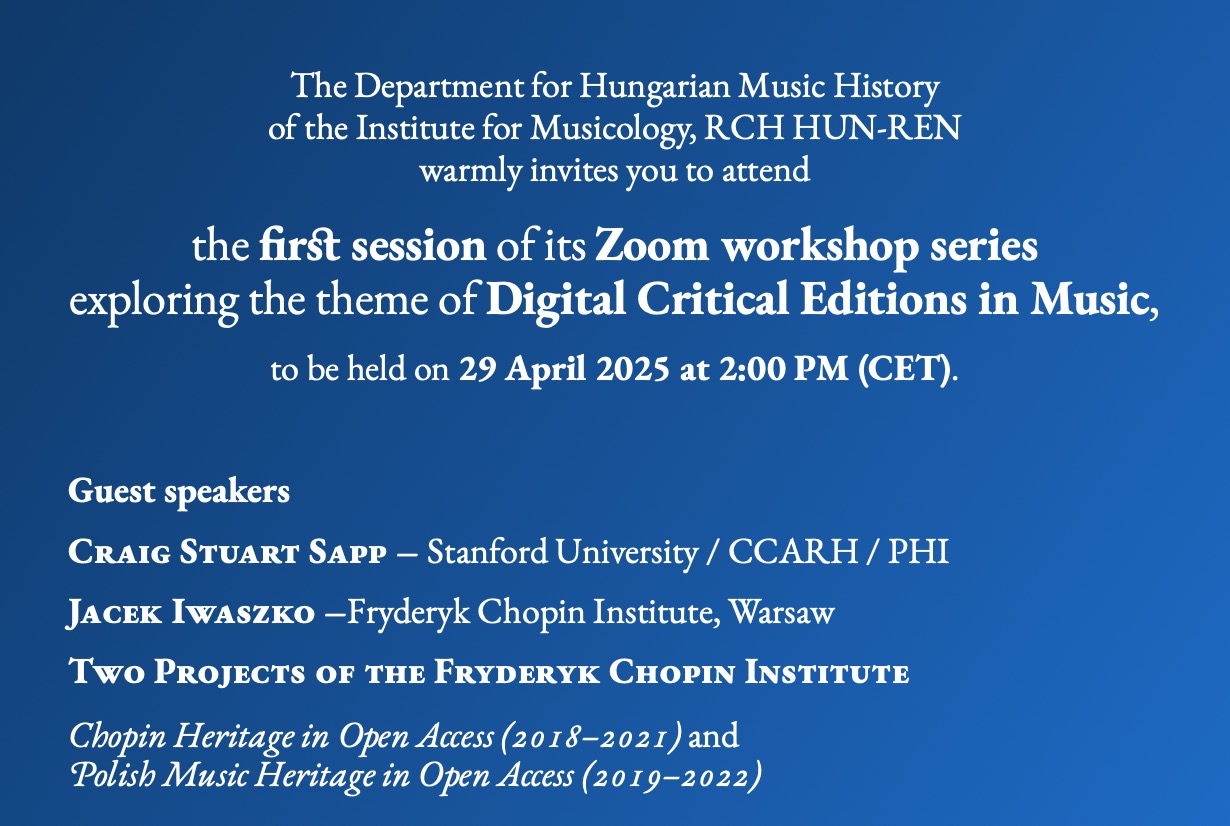
Monday, April 29, 2025, at 2:00 PM.
Jacek Iwaszko (Fryderyk Chopin Institute, Warsaw)
Craig Stuart Sapp (Stanford University / CCARH / PHI)
Two Projects of the Fryderyk Chopin Institute
Chopin Heritage in Open Access (2018–2021) and Polish Music Heritage in Open Access (2019–2022)
The detailed invitation can be downloaded here.
The presentation discusses the outcomes of two EU-funded projects conducted Fryderyk Chopin Institute between 2018 and 2022.
Among the results of the Chopin Heritage in Open Access project (2018–2021) is the portal chopinscores.org, featuring over 500 digital scores of Chopin’s first editions encoded in the Humdrum format. The platform offers advanced tools for analysis and comparison, including melody, rhythm, and interval search, tonal analysis, and dynamic score visualization.
The Polish Music Heritage in Open Access project (2019–2022) extends these methods to a broader repertoire of music from the 16th to 19th centuries. Creating 8,000 digital scores in Humdrum format required the development of a Git-based editorial workflow. The polishscores.org portal offers an advanced musical search engine, filtering options, and an analytical toolkit. All scores are available under an open license in multiple formats, providing a scalable model for digital editing, access, and computational analysis.
Digital Critical Editions in Music 2. – Critical Text and Digital Interactive Database of Čiurlionis’s Piano Music
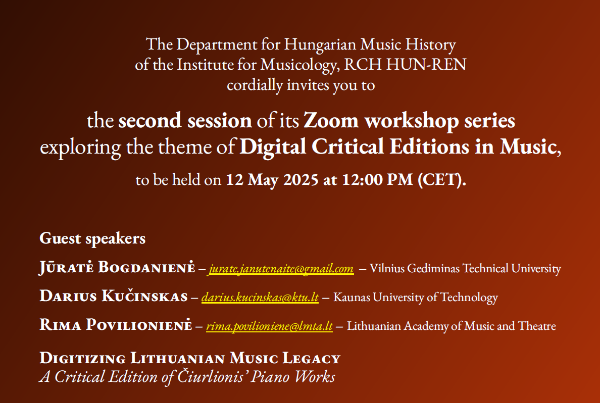
Monday, May 12, 2025, at 12:00 PM.
Jūratė Bogdanienė (Vilnius Gediminas Technical University)
Darius Kučinskas (Kaunas University of Technology)
Rima Povilionienė (Lithuanian Academy of Music and Theatre)
Critical Text and Digital Interactive Database of Čiurlionis’s Piano Music (https://piano.ciurlionis.eu/)
The detailed invitation can be downloaded here.
The session presents a 2022–2024 research focused on the piano music of renowned Lithuanian composer and painter Mikalojus Konstantinas Čiurlionis. The research was funded by Research Council of Lithuania under the project Critical Text and Digital Interactive Database of Čiurlionis’s Piano Music (No. P-LIP-22-101). The goal was to prepare a critical edition of the composer’s piano works and to publish it as an interactive database, aiming to reflect broader trends in contemporary (digital) editing and publishing of musical works. The developed database includes both complete and incomplete piano works by Čiurlionis, as well as sketches and fragments. The access to 356 entries of digital scores, combining XML-coded variants and critical editions linked and presented alongside their autographs, contemporaneous transcriptions, previous publications, and detailed commentary, and is available at https://piano.ciurlionis.eu/. Additionally, a unique search algorithm was programmed and integrated into the database, enabling music information retrieval based on basic criteria and allowing for comparative analysis of the works and fragments contained within the system.
Digital Critical Editions in Music 3. – Beethovens Werkstatt: A Digital Edition of Notirungsbuch K.
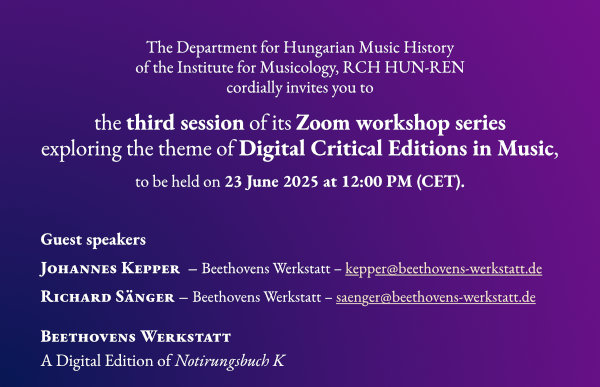
Monday, June 23, 2025, at 12:00 PM.
Johannes Kepper (Beethovens Werkstatt)
Richard Sänger (Beethovens Werkstatt)
Beethovens Werkstatt
A Digital Edition of Notirungsbuch K.
The detailed invitation can be downloaded here.
The basic musicological research project “Beethoven’s Workshop” focuses on genetic text criticism combined with digital music editing, offering new perspectives in musicological research. This project examines Beethoven’s compositional processes and employs digital technologies to disseminate its findings.
In the fourth module, which addresses sketches, Beethoven’s sketchbook from early 1823, known as Notirungsbuch K, will be digitally reconstructed and made accessible. Each sketch’s scriptural characters will be recorded from the manuscripts and correlated with corresponding diplomatic and annotated transcriptions. This linkage aims to create an animated presentation that transparently illustrates the transition from facsimile to transcription, or from recording findings to interpretation, for users.
In this presentation, we will introduce the project and its methodological approaches, explain the use of digital tools, mechanisms of the encoding, and present the results and objectives of the fourth module of “Beethoven’s Werkstatt.” The presentation will highlight the advantages of digital music editing for research and teaching, such as enabling collaborative work, interactive visualization of text variants, and the provision of comprehensive metadata.
Digital Critical Editions in Music 4. – E-LAUTE: An Electronic Linked Annotated Unified Tablature Edition

Wednesday, December 10, 2025, at 2:00 PM
Kateryna Schöning, PD Dr (University of Vienna)
Ilias Kyriazis, MMus, MA, MLS (Austrian National Library)
E-LAUTE
An Electronic Linked Annotated Unified Tablature Edition
The detailed invitation can be downloaded here.
E-LAUTE (Electronic Linked Annotated Unified Tablature Edition, https://e-laute.info) is a research project establishing an open-access, comprehensive, interactive edition of music in lute tablature from the German-speaking area 1450-1550. Though formerly well-known and widely performed, this corpus has become inaccessible to scholars, musicians, and the general public due to its complex notation and its sources being scattered throughout Central Europe. E-LAUTE sustainably digitises this part of European cultural heritage as machine-readable encodings, unlocked for a contemporary audience through transcriptions and professional recordings. The data is enriched with music-historical and performance-practical metadata, forming the basis for a novel form of music edition, an ‘open knowledge platform’, in which musicology, music practice, music informatics, and literary studies intertwine. The edition is permanently hosted by the Austrian National Library (ÖNB, https://edition.onb.ac.at/ context:elaute). The presentation will offer an overview of the project, addressing both content and technical characteristics


